
This $2M Data Competition Might Be The Portfolio Project That Finally Gets You Hired
(It's not with the Titanic Dataset...)

You’re building your portfolio. Again.
You’ve got three half-finished projects sitting in GitHub.
You’re wondering if you should start another one. Or maybe rebuild the old ones.
Or maybe you want to give up entirely because every “junior data scientist” job you see requires 5 years of experience anyway.
Spoiler alert, your portfolio isn’t failing because your projects aren’t technical enough, but because they don’t prove you can think like a data scientist.

Buuuuut, Penelope, what do you mean by “think like a data scientist????”.
I just found a Kaggle competition that might change that and it’s offering over $2 million in prizes to solve one of the hardest problems in AI right now.
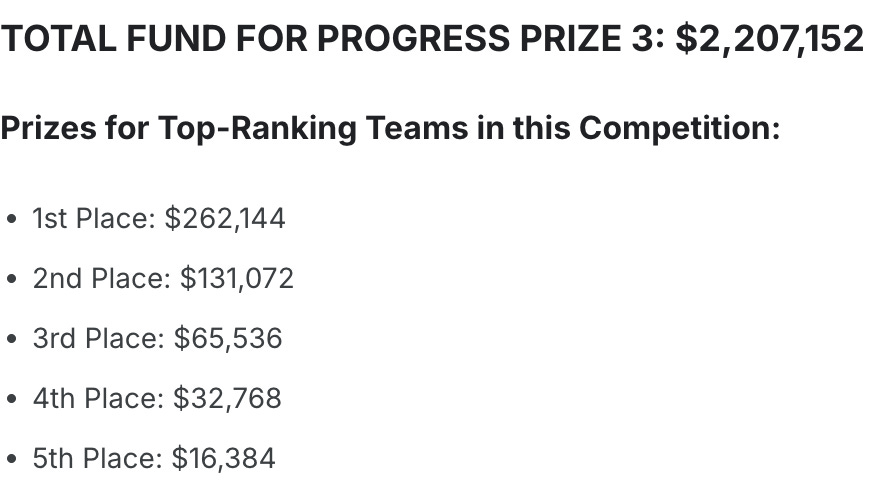
And even if you don’t win (most people won’t), just attempting it could become the portfolio project that finally gets you noticed.
What Is AIMO Progress Prize 3?
The AI Mathematical Olympiad Prize is a $10 million fund designed to push open-source AI toward gold-medal-level mathematical reasoning.
Translation: Teaching AI to solve the kind of math problems that make the brightest high school students in the world sweat.
This third iteration (AIMO3) just launched on Kaggle with:
$2.2 million total prize pool
$1.5 million+ for the grand prize winner (if they hit 47/50 on both test sets)
110 entirely original problems — zero risk of data contamination
Problems designed to be “AI hard” — they require genuine reasoning, not just pattern matching
And it ends April 15th, 2026.
But the part that made me stop scrolling is that you don’t have to win to make this worth your time.
Because what this competition actually tests:
breaking down ambiguous problems,
reasoning under constraints,
building systems that work with limited compute.
This is EXACTLY what separates portfolio projects that get ignored from portfolio projects that get interviews.
This Solves Your Biggest Portfolio Problem
Hiring managers are NOT impressed by another tutorial project.
They’re looking for proof that you can think strategically, not just code correctly.
And that’s where most portfolios fail.

You’ve got the technical skills. You can train a model. You can write clean code. But can you:
Break down a problem no one’s solved before?
Work within real-world constraints (limited compute, no internet access, tight deadlines)?
Make strategic tradeoffs instead of just throwing more layers at the problem?
Document your thinking process so someone else could reproduce your work?
That’s what this competition forces you to do.
Because when you show up to an interview and say:
“I competed in the AIMO Progress Prize. Here’s how I approached IMO-level math problems under compute constraints. Here’s what worked, what failed, and what I’d do differently next time.”
You’re suddenly in a completely different conversation than the person with just another Titanic notebook.
What Makes This Competition Different (And Useful for Your Portfolio)
Here’s what makes AIMO3 brutal in the best way:
1. No Multiple Choice, No Partial Credit
Every problem is solvable, but your model gets two attempts.
Answers are integers between 0 and 99,999. That’s it.
The scoring system penalizes guessing:
Both correct = 1 point
One correct, one wrong = 0.5 points
Both wrong = 0 points
Your model has to actually understand what the problem is asking.
Sound familiar? That’s exactly what happens on the job when someone says “Figure out why our conversion rate dropped” and walks away.
2. Production-Ready Constraints
Submissions run on limited compute (5 hours GPU max), with no internet access during inference.
You can’t just throw compute at the problem until it works.
You have to build a system that thinks efficiently.
That’s the exact skill you need in production environments where inference latency matters and compute budgets are real.
3. It Rewards Documentation, Not Just Results
There are auxiliary prizes for:
Best writeup (2x $15K) — document your methodology like an academic paper
Best dataset contribution ($30K) — create resources that help the community
Hardest problem solved ($30K) — prove you can tackle what others can’t
Translation: Process matters as much as performance.
How to Actually Use This (Even If You Don’t Compete)
Here’s my honest take on whether you should compete:
If you’re still building your first portfolio project:
Don’t compete yet. But study the reference problems. Reverse-engineer how the winners approached reasoning. Learn what “thinking through constraints” actually looks like.
If you’ve got 1-2 portfolio projects already:
This could be your differentiator. Even attempting a few problems and documenting your approach gives you a story that 99% of candidates don’t have.
If you’re struggling to stand out in interviews:
Use this competition framework to rebuild an existing portfolio project. Show production thinking: limited compute, systematic testing, documented tradeoffs.
Other Resources for Building Portfolio Projects That Actually Get You Hired
End-to-End ML Projects: Krish Naik’s Production ML Playlist
Shows you the full lifecycle from problem framing to cloud deployment
Real-Time Data APIs: Awesome Public Real-Time Datasets GitHub Repository
100+ free APIs so you stop building with Titanic and iris flowers
Portfolio Review Tool: My Claude Skills Project Analyzer
Evaluates your projects from a hiring manager’s perspective
Keep growing,
It feels daunting Penelope.